✦ This post contains affiliate links. As an Amazon Associate, I earn from qualifying purchases at no extra cost to you. I only share things I genuinely use and love.
✦ ✦ ✦
The single most common question beginners ask is: “Which deck should I get?” And the honest answer is: the one you’ll actually want to look at every day.
For a long time, the standard advice was to start with the Rider-Waite-Smith — the classic deck that most guidebooks and learning resources are built around. That’s still good advice. But it’s not the only advice anymore.
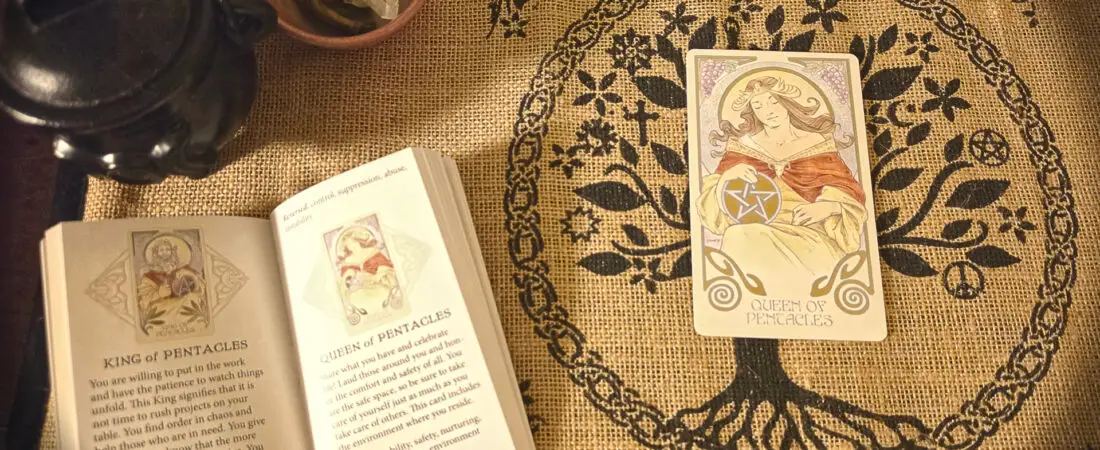
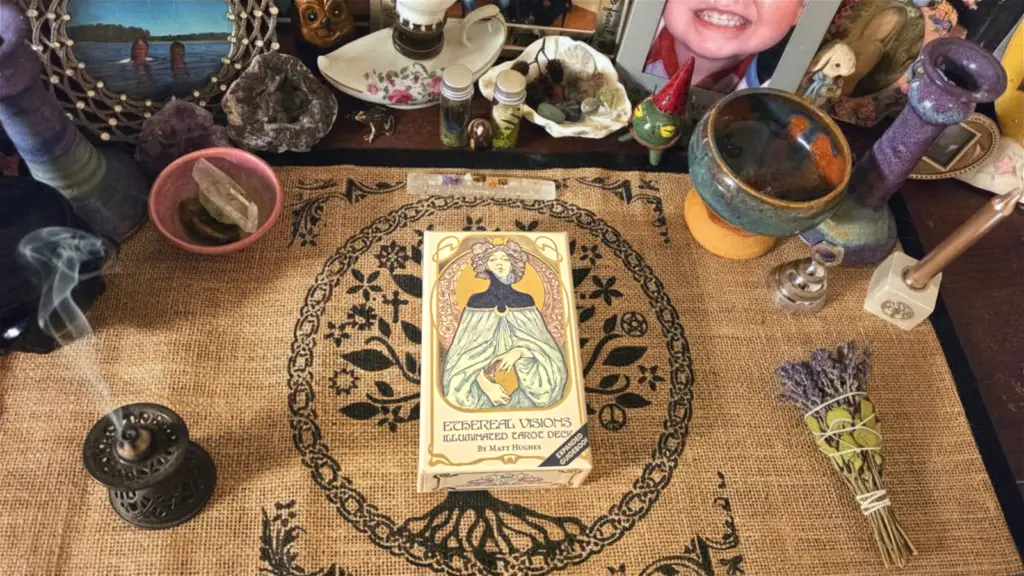
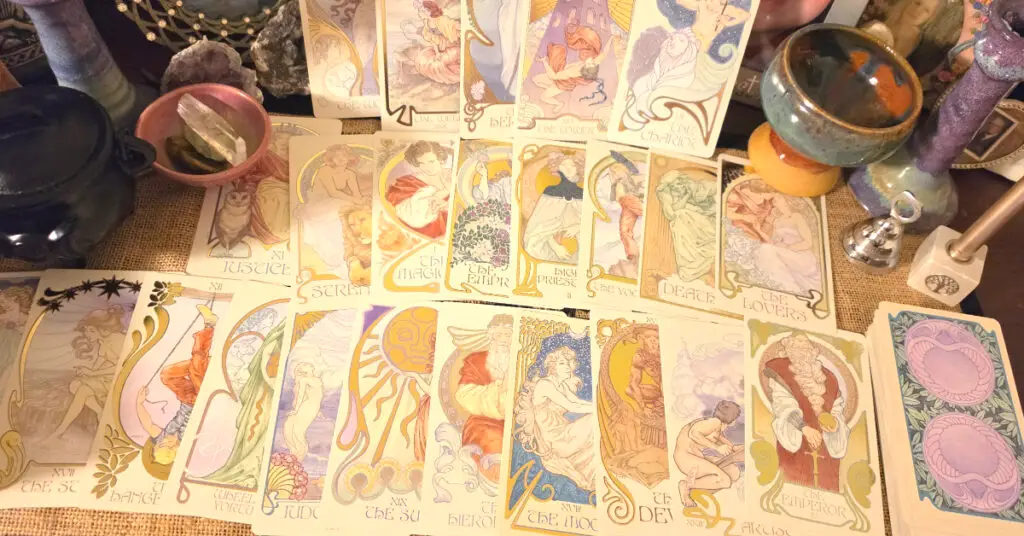
One of my most used decks is the Ethereal Visions Illuminated Tarot, and I recommend it to beginners without hesitation. It’s based on the Rider-Waite system, so every book and reference guide you pick up will map directly onto it — but the art is rich and atmospheric in a way the original simply isn’t. Art Nouveau linework, gold gilded edges, imagery that feels like it belongs in a fairy tale or an illuminated manuscript. It reads intuitively, which matters more than people realize when you’re starting out. When a card is hard to look at, you’ll unconsciously avoid it. When your deck feels like something precious, you’ll reach for it.
The Ethereal Visions is already very reasonably priced for what it is, and your deck is the one thing worth choosing with your whole heart rather than your budget. That said, if you genuinely need to start with the standard, the Authentic Rider-Waite-Smith is widely available and remade by many people and every learning resource you’ll ever find is built around it. There is a cheap beginner Rider-Waite deck with meanings on the cards.
One note on buying your first deck: ignore the old superstition that your deck has to be gifted to you. Buy your own. Choose it intentionally. That’s its own kind of magic.
✦ ✦ ✦
An altar cloth: creating a dedicated space
Before you lay your first card, I’d encourage you to think about where you’ll read. Not because tarot requires a perfectly curated sacred space — it absolutely does not — but because having a designated surface changes how you show up for a reading.
I use the Indian Consigners altar cloth as my reading surface. It’s a simple practice: spreading the cloth signals to your brain that this is intentional time. It protects your cards, keeps them clean, and creates a little boundary between the reading and everything else happening on your desk.
Any cloth you love works. A square of linen or velvet from a fabric store works just as well if you have something on hand. This one is mine, and I love it.
✦ ✦ ✦
A bag or wrap for your deck
Tarot cards pick up energy — or at least, treating them like they do is a useful habit. Most readers keep their deck wrapped or stored separately from everyday objects. This isn’t superstition so much as it’s respect for something you’re investing time and attention in. I made my tarot wrap from black and patterned cotton fabrics and a string sewn on the side. But you don’t have to go through that much effort.
Everyday option: A simple velvet drawstring pouch — inexpensive, soft, and does exactly what it needs to do. You can find these in every color imaginable.
Upgrade: An embroidered velvet tarot bag — something with a little more intention behind it. Celestial motifs, botanical embroidery, moon phases. If you’re going to reach for this bag every day, it might as well feel like a small treasure.
✦ ✦ ✦
A journal: the tool most beginners skip
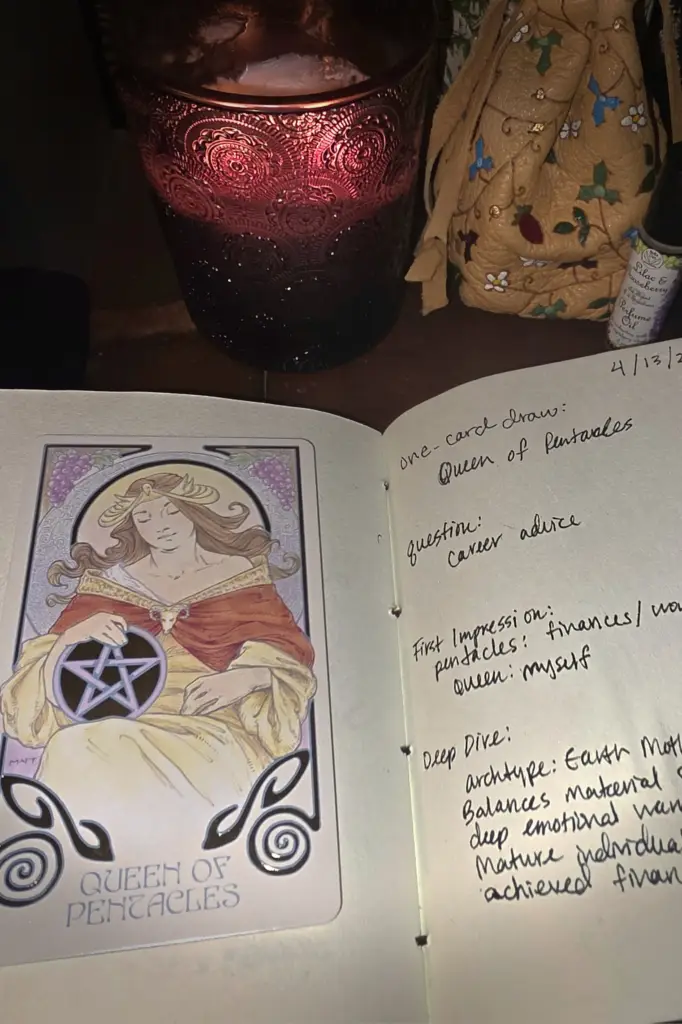
This one is non-negotiable for me. A tarot journal is how you actually learn tarot — not by memorizing the 78 card meanings before you start, but by pulling cards and writing down what you notice, what you felt, what surprised you, and what turned out to be true.
Over time your journal becomes your personal reference — more useful than any guidebook, because it’s built from your own readings and your own life.
Everyday option: An A5 dotted notebook —Dotted pages give you flexibility for sketches, symbols, and freeform notes without the rigidity of lines. Sturdy, reliable, unpretentious
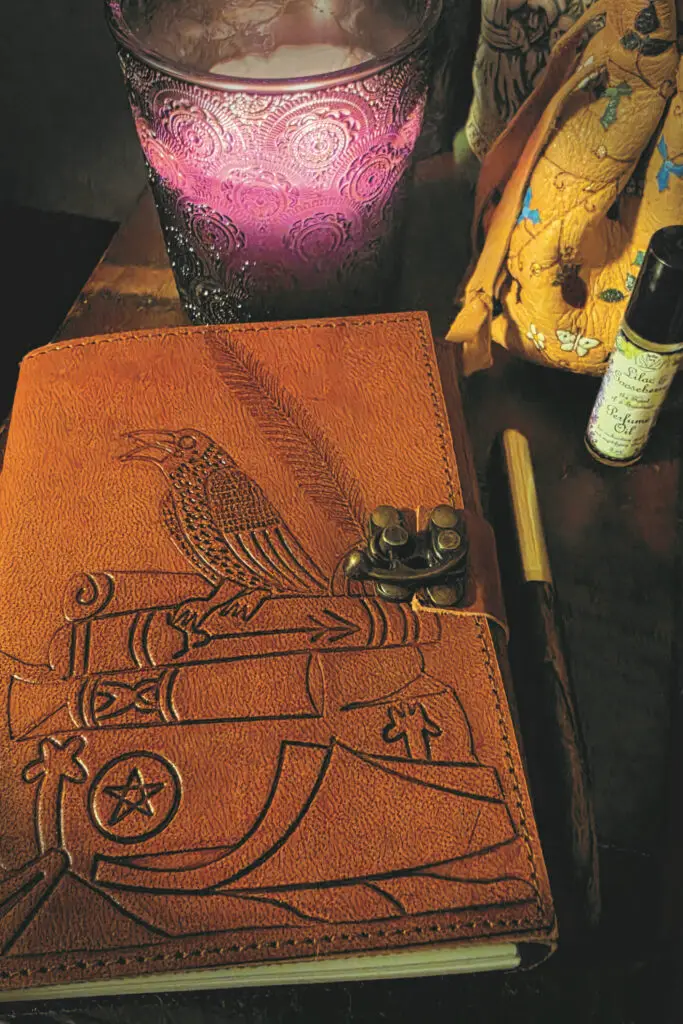
Upgrade: A big leather-bound journal with thick pages — the kind that feels like a grimoire rather than a notebook. Lay-flat binding, creamy unlined pages, the satisfying weight of something built to last. If the journal feels sacred, you’ll treat the practice that way too. There are also plenty of mid-range leather-bound journals. I use one I got at a craft fair similar to the link. Personally, I recommend keeping it simple here—I’ve bought beautiful journals in the past and then was too afraid to use them and “mess them up”.
✦ ✦ ✦
A pen: because writing by hand matters
When journaling feels good, you do more of it. It’s that simple. A pen that writes smoothly and fits well in your hand turns a habit into a small ritual.
Everyday option: The Cobee fountain pen — this is the one I actually use, and at $9 it is genuinely one of the best budget fountain pens available. Fountain pens write differently than ballpoints; the ink flows, the pressure is lighter, and the whole experience of writing slows down in the best way. Start here. You may never feel the need to upgrade.
Upgrade: The Pilot Metropolitan — a step up in weight and craftsmanship, widely considered the best entry-level fountain pen for people who’ve caught the bug. Brass body, a smooth nib, and it will last you years. Worth it if you find yourself reaching for the Cobee every single day and wanting more. Or if you’re feeling really fancy or want to gift a pen, the Schrivner British racing pen is gorgeous.
✦ ✦ ✦
A guidebook: how to actually learn the cards
You don’t need to memorize the 78 cards before your first reading. You need a good reference to reach for when a card stops you.
Everyday option: The Ultimate Guide to Tarot by Liz Dean — clear, accessible, well-organized, and affordable. Solid card-by-card reference that won’t overwhelm a beginner.
✦ ✦ ✦
Candles: setting the atmosphere
I never do a reading without a candle lit somewhere nearby. This is less about ritual necessity and more about what it does to the room — and to my attention.
Everyday option: A natural beeswax or soy taper candle — clean burn, no synthetics, simple and right. Light one before you begin, and it will do its job beautifully.
Upgrade: Bookish reading candles — small-batch, literary-themed, and they smell exactly like the kind of evening you want to have when you’re sitting with your cards. The two currently living on my reading altar are Stars Hollow (yes, from Gilmore Girls — cozy, autumnal, smells like a town where it’s always October and someone is always making coffee) and Night Court (from A Court of Thorns and Roses, for when the reading calls for something darker and more complicated). I have no regrets about either of them.
✦ ✦ ✦
An optional touch: scent
This one is personal, and I include it because it made an unexpected difference in my practice. Scent is one of the most powerful anchors for attention and memory. When I wear the same fragrance for readings, my brain learns to associate that smell with a particular quality of focus — settled, present, ready.
The Bella des Natural Beauty Lilac and Gooseberries perfume oil is the one currently living on my reading altar, and I want to be upfront: it is literally marketed as Yennefer of Vengerberg’s signature scent, and I bought it knowing that full well, and I have zero shame about it. It smells like spring lilac and bright gooseberry — delicate but not sweet, with that slightly green, living quality that feels like something just woke up in the garden. It’s a genuinely beautiful fragrance that happens to also make me feel like a morally ambiguous sorceress with impeccable taste and strong opinions, which is frankly a great headspace for a tarot reading.
Practically speaking, it’s a concentrated roll-on oil in a small glass bottle, which means it lasts a long time, travels well, and applies with more control than a spray. The formula is clean — no phthalates, parabens, or petroleum derivatives, vegan and cruelty-free, handmade in Michigan. The oil base releases the scent slowly against your skin rather than announcing itself to the entire room, which I prefer for the intimacy of a reading practice.
You don’t need a special scent to read tarot. But if you find one that feels right, it becomes part of the ritual in a way that sneaks up on you. And if that scent also makes you feel like you could level a city with your bare hands if you wanted to, that’s between you and the cards.
✦ ✦ ✦
Putting it all together: your first reading
Once you have your deck and your space set, here’s how to begin:
Clear a surface and lay down your cloth. Light a candle. Hold your deck in both hands for a moment before you shuffle — some readers breathe, some set an intention, some simply sit in silence for a few seconds. Whatever helps you arrive.
Shuffle until it feels right. Pull one card.
Write the date in your journal. Write the card’s name. Write what you notice in the image before you look anything up. Then check your guidebook. Then write what resonates and what doesn’t.
That’s it. That’s your first reading.
Do this every day for a month, even if it’s just one card. You will know your deck differently at the end of that month than you do right now, and differently again at the end of the next one. Tarot is a practice, not a performance — it rewards showing up steadily far more than it rewards doing it perfectly.
✦ ✦ ✦
The Full List
You don’t need all of it to begin. The deck, a notebook, and a pen are enough. Add the rest as you settle into your practice.